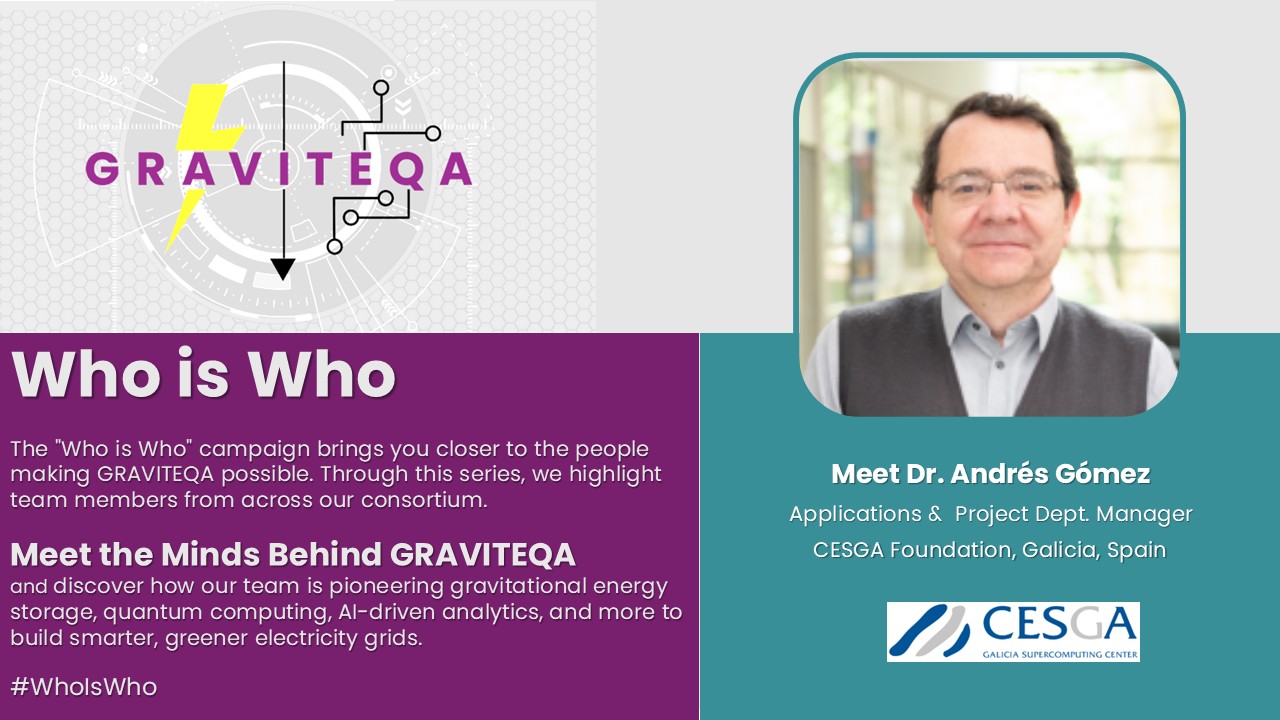
Who is Who – Meet Dr. Andrés Gómez, CESGA Foundation, Galicia, Spain
As part of our Who is Who interview series, we are delighted to introduce Dr. Andrés Gómez from CESGA Foundation in Galicia, Spain. With extensive experience in High-Performance Computing (HPC) and quantum technologies, Dr. Gómez brings a wealth of knowledge and insight to the objectives of the GRAVITEQA project. In this interview, he shares his professional journey, his work at CESGA, and his perspective on how advanced computing and emerging quantum technologies can support the project’s ambitions and the broader scientific community.
Dear Andrés, thank you for taking the time to participate in this interview. We’re excited to hear your thoughts and learn more about your contributions to the GRAVITEQA project
Could you start by telling us a little about yourself and your professional background?
I am the Applications and Projects Manager at the Galicia Supercomputing Center (CESGA), where I lead the strategic area of Quantum Computing, especially the integration of High-Performance Computing (HPC) and quantum technologies. I hold a PhD in Physics from the University of Santiago de Compostela. My career has been defined by bridging the gap between academic research and industrial application. My professional background includes various leadership roles in the private sector at companies such as Unisys and Tromosa, which provided me with a practical perspective on digital transformation and the deployment of complex technological systems.
Currently, my work focuses on the development of hybrid HPC-Quantum architectures and the applications of Quantum Computing. I am deeply involved in research regarding distributed quantum computing and its practical adoption, aiming to position these frontier technologies as key drivers for innovation. With more than 50 scientific publications, my aim is to facilitate the transition of quantum advancements to functional tools for the research and industrial landscapes.
Could you explain the role your organization plays in the GRAVITEQA project?
CESGA is involved in the research and development of algorithms that use the quantum capabilities in two cases: the Load-side Management for Flexibility Provisioning (LMFP) which focuses on the coordination of distributed flexible assets connected to the electrical grid to ensure that aggregated demand satisfies a control requirement issued by a system operator, and the Facility Location Allocation (FLA) problem which addresses strategic planning decisions related to the selection, location, and configuration of energy generation facilities. We research these topics in close collaboration with other partners, especially with CARTIF and FSAS. These problems can be modelled as combinatorial optimization, where Quantum Computing could provide an advantage. Our aim is to compare these solutions with classical and quantum-inspire tools.
Additionally, we lead the workpackage for validation of the GRAVITEQA solutions. In this workpackage we will evaluate if the full set of GRAVITEQA solutions, not only the quantum solutions we develop, solves accurately the set of identified uses cases. This means, if the tools fit in their purpose.
What makes it crucial to take an innovative or unconventional approach when working on Quantum Computing?
Exploring the capabilities of Quantum Computing for different problems and sectors is really a must, because we are in the initial stages of the development of a disruptive technology. It is important to understand where we can apply now and in the future. In this project, we will research in its applicability to important and difficult problems in the energy sector, where quality and speed of solutions to complex management and planification problems are demanded and are needed.
What have been some of the main obstacles you’ve encountered in this project, and how are you working to address them?
The first difficulty was the definition of the mathematical models of these problems, taking into account the restrictions of the quantum-inspired and quantum technologies. Thanks to the excellent work of our partners in GRAVITEQA, the FSAS, CARTIF and CESGA team has now a mathematical model that fits in the three computational paradigms: classical, quantum-inspired and quantum.
But now we have to tackle a second issue in quantum computing: the scalability. We are researching in the recent hybrid algorithms as QAOA and PCE to know if they can solve the problems, and if the solution has enough quality. Currently, we are using classical emulation of the quantum computing, that it is slow for the purpose. Accessing real quantum computers is expensive, because they are scarce. Although CESGA has its own quantum computer, QMIO, its capabilities are not enough for real industrial problems of the type that we are researching. So, we have an important challenge, that motivates us.
Looking ahead, what are your hopes for the GRAVITEQA project’s outcomes? How do you see it influencing the energy sector moving forward?
Our vision for the future is that quantum computing can be applied successfully to problems that are important for the energy sector and that currently are difficult to solve with available computing classical resources. We hope that we can generate useful tools that will allow the sector to make a better management and planning of services.
We appreciate you sharing your insights with us today.