Meet Prof. Georgios C. Christoforidis, University of Western Macedonia (UoWM)
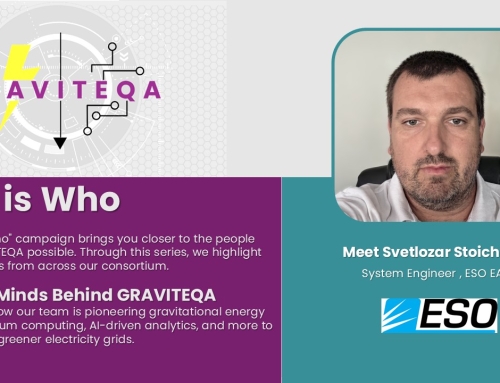
As part of our Who is Who interview series, we are delighted to introduce Professor Georgios C. Christoforidis, a key member of the GRAVITEQA consortium. With extensive experience in Electrical Power Systems and a strong background in research and innovation, Prof. Christoforidis and UoWM team bring valuable expertise to the project’s mission of transforming decommissioned coal power plants and mines into sustainable energy storage systems. In this interview, he shares insights into his work, the challenges faced, and his vision for the energy transition.
Could you start by telling us a little about yourself and your professional background?
I am Georgios C. Christoforidis, a Professor in Electrical Power Systems at the Department of Electrical and Computer Engineering at the University of Western Macedonia. I served as Head of the Department from 2020 to 2025, and since August 2025, I have been Vice Rector of Research and Innovation at the same University. I hold a degree in Electrical Engineering from the Aristotle University of Thessaloniki (1998), an MSc in Power Electronics & Drives from the University of Birmingham, UK (1999), and a PhD from the Aristotle University of Thessaloniki (2004).
I have participated as a researcher and scientific coordinator in more than 25 international and national projects in the field of Electrical Power Systems. My academic work includes 56 papers in international peer-reviewed journals, 113 papers in international conference proceedings, and 2 books, with more than 2,500 citations (Google Scholar). I am a member of the Technical Chamber of Greece, CIGRE, ASHRAE, IEEE (Senior Member), ETIP SNET WG3, and EERA JP in Energy Storage.
Thank you, George, for the interesting introduction. Let’s dive deeper into your current role and contributions within the GRAVITEQA project.
Could you explain the role your organization plays in the GRAVITEQA initiative?
The Department of Electrical and Computer Engineering of the University of Western Macedonia is leading the research activities related to developing a holistic methodology for identifying the optimal energy storage solution to transform a coal power plant and mine into a long-duration energy storage system based on gravitational energy storage. We are also responsible for the activities concerning the recyclability of the under-decommissioning thermal power plants and abandoned mines.
What makes it crucial to take an innovative or unconventional approach when working on this topic?
The region of Western Macedonia in Greece has traditionally been the energy center of the country, where large lignite-fired power plants generated more than 70% of national energy needs. However, the gradual decommissioning of conventional power plants and the increased penetration of renewable energy sources have created a dual challenge.
First, the abandoned equipment (power plants and mines) can be repurposed to remain useful for the electricity grid, leveraging the strong transmission infrastructure already in place. Second, the volatile nature of renewable energy sources highlights the need for balancing resources to ensure grid stability.
Integrating large energy storage systems increases the resilience of the power system while minimizing renewable energy curtailment. The innovation behind GRAVITEQA’s hybrid storage solutions lies in developing an optimal gravitational storage-based solution that repurposes decommissioned assets while ensuring recyclability and participation in various electricity markets.
What have been some of the main obstacles you’ve encountered in this project, and how are you working to address them?
One major challenge is identifying which parts of the existing infrastructure—such as mine cars, generators, or hoisting materials—can be reused to create a sustainable gravitational storage solution. Literature on gravitational storage is still limited, and decommissioning approaches are often conceptual.
GRAVITEQA takes a step further by examining a real case study at the abandoned Kardia Power Station in Western Macedonia, Greece. To overcome these obstacles, close collaboration with the project partner PPC (Public Power Corporation), which owns most of Greece’s coal power plants, is key to bridging the gap between theoretical design and real-world implementation.
Looking ahead, what are your hopes for the GRAVITEQA project’s outcomes? How do you see it influencing the energy sector moving forward?
By implementing the proposed solutions, new opportunities emerge for repurposing decommissioned power plant and mining equipment. Instead of ending up as scrap, these assets can form the basis for sustainable storage solutions beneficial to both plant owners and the power grid.
The project’s impact will extend beyond Greece, offering a scalable and replicable model for Europe’s energy transition—facilitating the integration of variable renewable energy sources and contributing to a cleaner, more energy-independent Europe.
We sincerely thank Professor Georgios C. Christoforidis The Department of Electrical and Computer Engineering of the University of Western Macedonia (UoWM) for sharing his time and insights. His work exemplifies how innovation and engineering can reshape legacy infrastructure into sustainable assets for the future energy landscape.
Want to learn more on UoWM activities? Please visit GRAVITEQA News section
Stay tuned for more interviews in our Who is Who series, where we continue to spotlight the dedicated minds behind the GRAVITEQA project.
Follow the journey and join the conversation with #WhoIsWho!