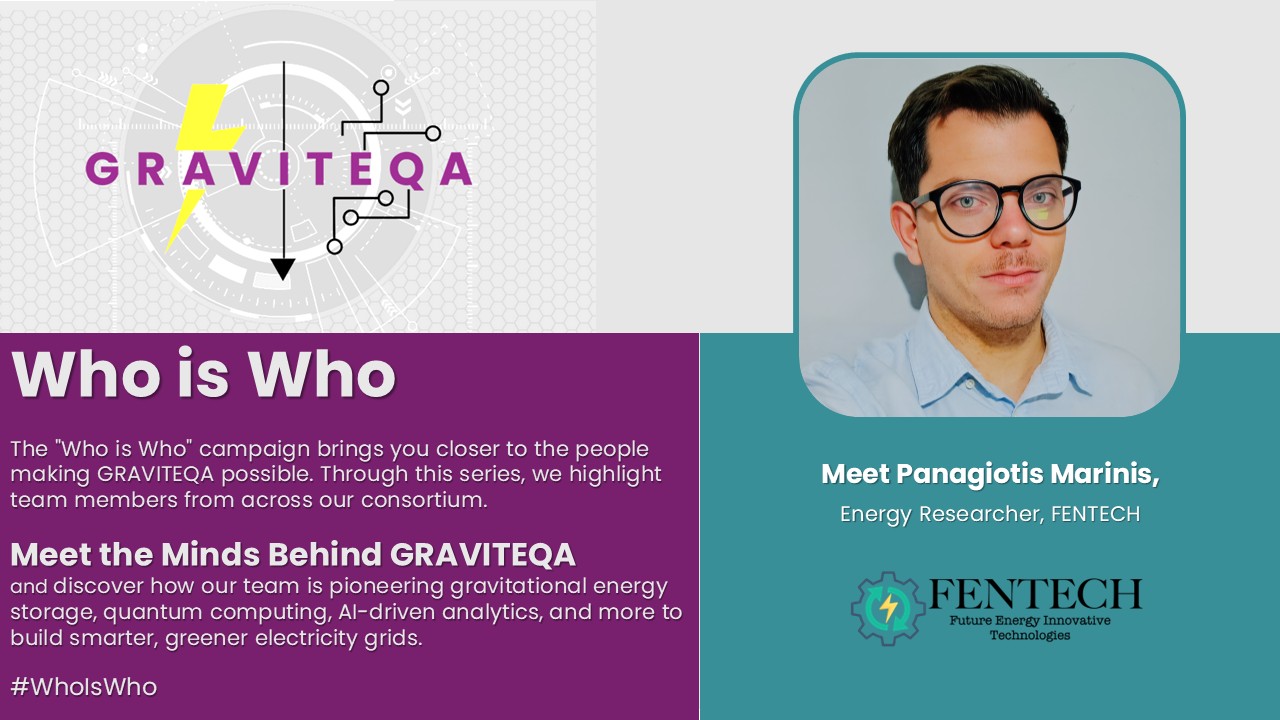
Who is Who – Meet Panagiotis Marinis, FENTECH, Greece
As part of our Who is Who interview series, we are delighted to introduce Panagiotis Marinis, Energy Researcher from FENTECH based in Greece.
In this interview, Panagiotis shares with us FENTECH’s role and contribution to the GRAVITEQA project. FENTECH is a key partner in the GRAVITEQA Project, serving as the technical coordinator. The company leads the requirements engineering process, ensuring a clear and robust definition of the project’s core developments. Through its coordination role, FENTECH aligns technical objectives with strategic innovation goals. It actively contributes cutting-edge technological solutions, particularly in the field of AI for grid operation. Additionally, FENTECH advances data-driven, quantification-based strategies to support sustainable and efficient green seaport operations.
Dear Panagiotis, thank you for being with us today.
Could you start by telling us a little about yourself and your professional background?
I’m 25 years old, and I’m an Electrical Engineer specialising in Power Systems. I hold a Master’s degree in Electrical and Computer Engineering from the University of Patras, where my thesis focused on residential flexibility aggregation. I also completed an internship at the Greek Distribution System Operator in the Construction Department. I am involved in GRAVITEQA project as an Energy Researcher of FENTECH and in particular I contribute to the requirements engineering, electrification studies for green seaports, infrastructure sizing for RES, and cost-benefit analysis for green transitioning.
Could you explain the role your organization plays in the GRAVITEQA project?
My organization, FENTECH, has a multifaceted role in the GRAVITEQA initiative. On the one hand, we contribute as tools developer. On the other hand, we also have a leading role in specific tasks, where we helped define the requirements the tools need to meet and worked on use cases to identify relevant applications and end users. In addition, we are involved in launching the validation process for the developed tools.
What makes it crucial to take an innovative or unconventional approach when working on Quantum Computing?
I believe it is crucial to take an innovative approach because the energy sector is constantly evolving, and as a critical infrastructure, it must always be able to meet demand. With increasing electrification and the integration of new technologies into the system, the need for flexibility is also growing. That is why we need new tools and new ways of thinking to address real-world complexity and deliver solutions that are both technically sound and practical for users.
What have been some of the main obstacles you’ve encountered in this project, and how are you working to address them?
One challenge has been ensuring that the tools we develop are closely aligned with real user needs and practical use cases, while also adding value to the European Union’s research portfolio. We are addressing this by continuously refining the end products so that the final outcome is both relevant and genuinely innovative.
Looking ahead, what are your hopes for the GRAVITEQA project’s outcomes? How do you see it influencing the energy sector moving forward?
Looking ahead, I hope GRAVITEQA will deliver outcomes that are practical and can be applied in real-world conditions. Ideally, the project will leave behind tools and knowledge that continue to be developed and adopted even after its completion, supporting innovation and helping the energy sector move toward smarter and more efficient solutions.
We appreciate you sharing your insights with us today.
Thank you for inviting me.
One more #WhoIsWho interview completed! Stay tuned for more in our Who is Who series, where we spotlight the dedicated minds behind the GRAVITEQA project.
Follow the journey and join the conversation with #WhoIsWho!