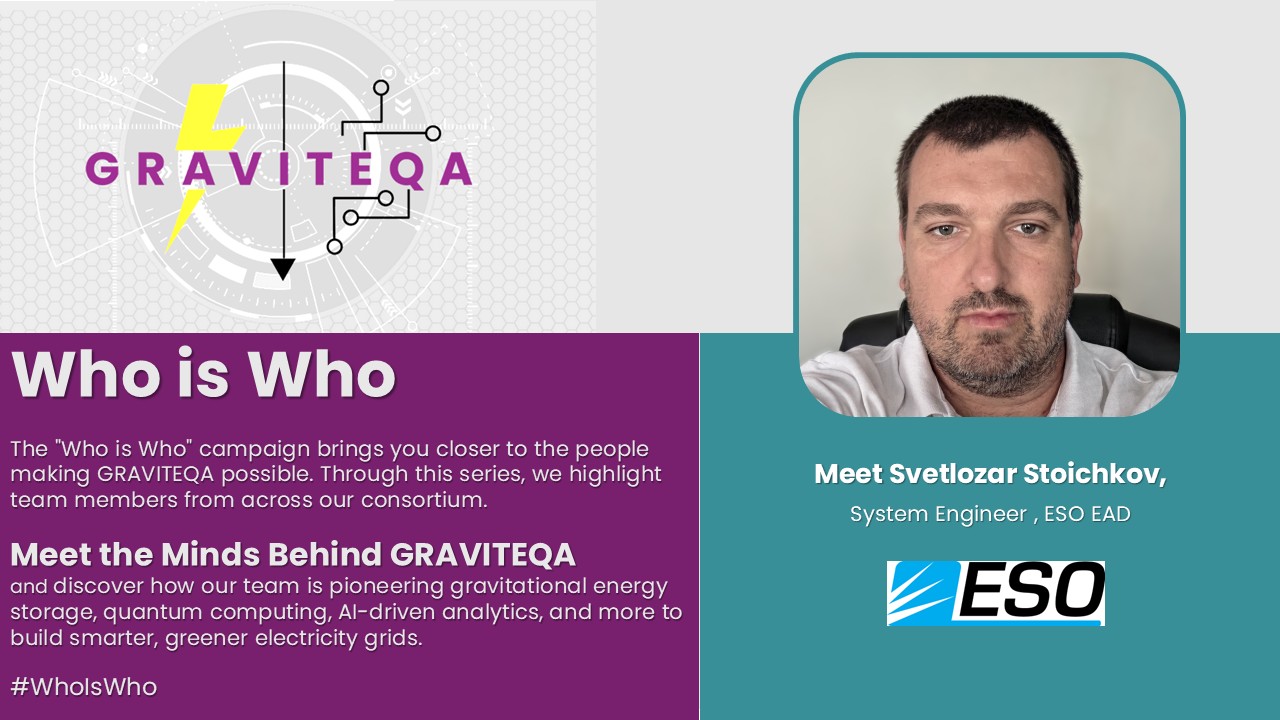
Who is Who – Meet Svetlozar Stoichkov, ESO, Bulgaria
As part of our Who is Who interview series, we are delighted to introduce Svetlozar Stoichkov, System Engineer in the SCADA Department at the Bulgarian Electricity System Operator (ESO EAD)
In this interview, Svetlozar shares insights into ESO EAD’s role in the GRAVITEQA project, its contribution to the development and validation of innovative solutions for future power systems, and the importance of bringing real-world transmission system expertise into research and innovation.
As a key industry partner and transmission system operator, ESO EAD contributes valuable operational expertise and practical insights, helping ensure that the technologies developed within GRAVITEQA can address real-world challenges in the electricity sector.
Dear Svetlozar, thank you for being with us today. We’re excited to hear your thoughts and learn more about your contributions to the GRAVITEQA project.
Could you start by telling us a little about yourself and your professional background?
I currently work as a System Engineer in the SCADA Department at the Bulgarian Electricity System Operator (ESO EAD), the company responsible for operating, maintaining, and developing Bulgaria’s electricity transmission network while ensuring the secure and reliable operation of the national power system.
I have been with the company since 2017. My responsibilities include supporting the infrastructure of the Central Dispatching Center and ensuring the reliable operation of systems used for real-time monitoring and control of the power system. This involves maintaining key network and cybersecurity components while ensuring high availability, security, and continuity of critical dispatching systems.
Regarding my education, I hold a bachelor’s degree in Information Technologies, a master’s degree in Information Security, and a second master’s degree in Telecommunications.
Over the years, I have gained solid experience in managing mission-critical OT infrastructure, troubleshooting complex technical issues, and maintaining high system availability in a demanding operational environment. I enjoy working with new technologies and continuously improving my technical knowledge and skills.
Could you explain the role ESO EAD plays in the GRAVITEQA project?
In the GRAVITEQA initiative, our organization—ESO EAD—plays the role of a transmission system operator and industry partner. We support the project by contributing operational expertise, sharing real-world requirements, and helping validate the proposed solutions from the perspective of a transmission system operator.
Our main contribution is providing the real-world operational context of the electricity transmission grid. This includes defining practical use cases, identifying operational challenges, and ensuring that the developed solutions are relevant to the way a transmission grid is actually operated.
We will also support the validation and testing of advanced methods, such as AI and optimization techniques, by evaluating them against real operational requirements, including reliability, congestion management, and integration of renewable energy sources.
In short, our role is to help ensure that the innovations developed within GRAVITEQA are not only theoretically sound, but also practical, applicable, and valuable for real-world power system operations.
What makes it crucial to take an innovative or unconventional approach when working on Quantum Computing?
The electricity grid is becoming increasingly complex due to the growing integration of renewable energy sources, the electrification of various sectors, and increasing requirements for resilience and cybersecurity. Traditional approaches are no longer sufficient to manage these challenges efficiently. That’s why innovative approaches are essential. Projects like GRAVITEQA are important because they explore and validate advanced technologies, such as artificial intelligence and quantum computing, which have the potential to improve power system operation, optimize decision-making, and enhance the reliability and resilience of future electricity grids.
What have been some of the main obstacles you’ve encountered in this project, and how are you working to address them?
One of the main challenges during the first phase of the project was aligning the different perspectives and expertise of all partners, since GRAVITEQA brings together universities, research organizations, and industry partners. It took some time to establish a common understanding of the objectives, technical requirements, and expected outcomes. We addressed this through regular meetings, continuous communication, and close collaboration when preparing project deliverables. This has helped keep the project well-coordinated and ensured that the research remains relevant to real-world power system applications.
Looking ahead, what are your hopes for the GRAVITEQA project’s outcomes? How do you see it influencing the energy sector moving forward?
I hope GRAVITEQA will demonstrate how advanced technologies like AI and quantum computing can help system operators manage the increasing complexity of modern power grids; especially as renewable energy integration continues to grow. I also hope the project will contribute to the development of practical, reliable solutions that support transmission system operators in addressing the challenges of future power system operation and will strengthen collaboration between research institutions and transmission system operators, ensuring that new technologies are both innovative and suitable for real-world deployment.
We appreciate you sharing your insights with us today.
One more #WhoIsWho interview completed!
Want to learn more about ESO EAD’s contribution to GRAVITEQA? Read the article published by ESO EAD in the Bulgarian energy magazine Energetics – Electricity Perspectives (Issue 25/2025, November), titled “Artificial Intelligence and Digitalization in the Energy Sector.”
Stay tuned for more in our Who is Who series, where we spotlight the dedicated minds behind the GRAVITEQA project.
Follow the journey and join the conversation with #WhoIsWho!